Last reviewed: October 2026
Whether you can see the northern lights tonight depends on three things: how strong the geomagnetic activity is, how dark your sky is, and whether clouds get in the way. Auroras can’t be promised from one night to the next, so this guide focuses on how to check the live forecast yourself, when to look, and where to go.
What Are the Northern Lights?
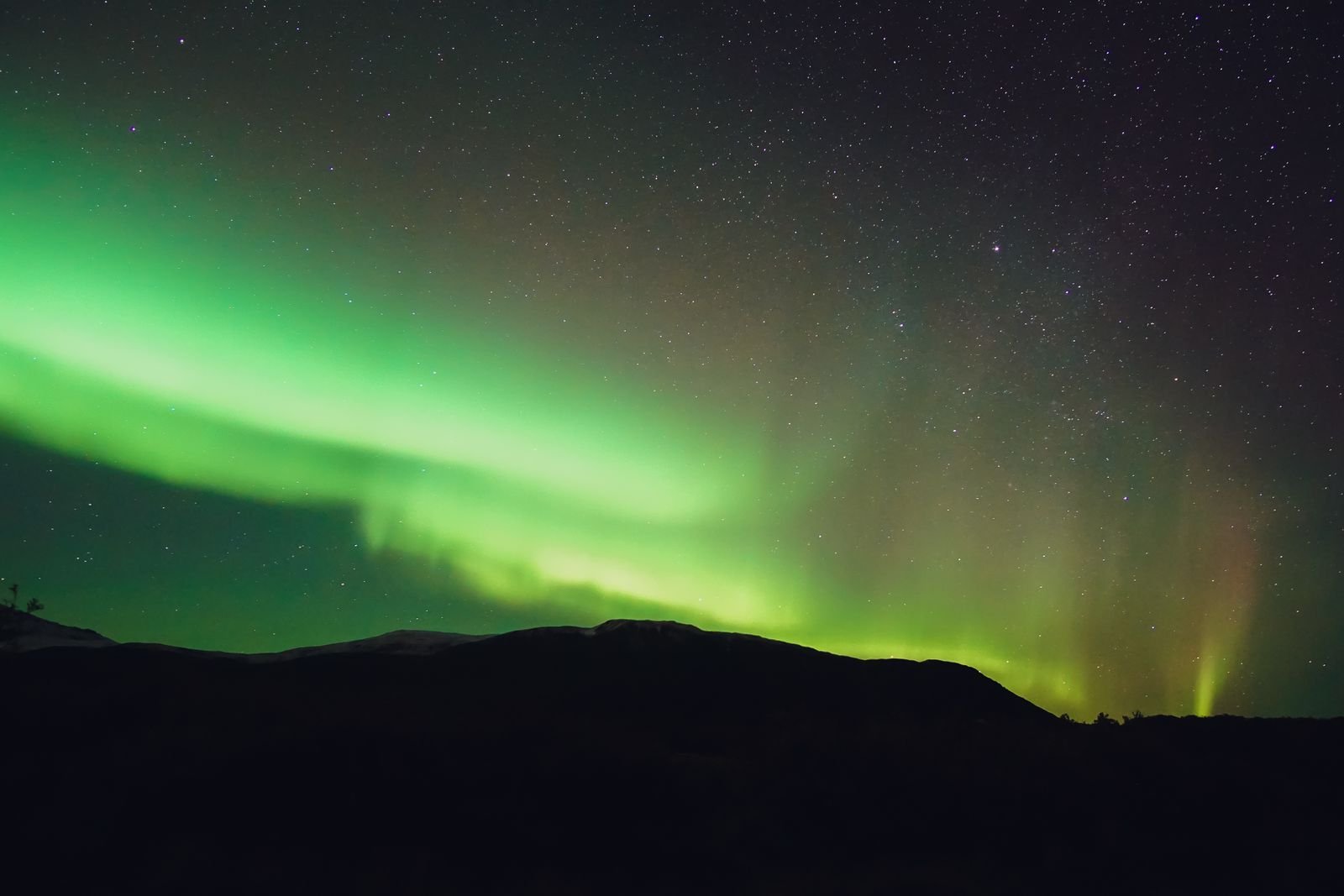
The northern lights (aurora borealis) happen when charged particles from the Sun, carried by the solar wind, interact with Earth’s magnetic field and are guided toward the polar regions. There they collide with gases in the upper atmosphere and release light. Oxygen at lower altitudes typically produces green, higher-altitude oxygen can give red, and nitrogen can add blue or purple edges. The southern counterpart is the aurora australis.
How to Check Whether the Aurora Is Visible Tonight
Use live data rather than a blog post, since conditions change within hours. Reliable sources include:
- NOAA Space Weather Prediction Center, which publishes the aurora forecast, the 3-day Kp outlook, and real-time solar wind readings.
- A local weather forecast for cloud cover. Even a strong aurora is hidden by thick cloud.
- Aurora alert apps that use NOAA data and send notifications when activity rises near you.
Understanding the Kp Index
The Kp index rates geomagnetic activity from 0 to 9. NOAA’s storm scale links stronger activity to auroras being visible farther from the poles. As a rough guide from NOAA’s descriptions:
| Kp level | NOAA storm level | Where aurora may be seen |
|---|---|---|
| 5 | G1 (minor) | High latitudes, such as northern Michigan and Maine |
| 6 | G2 (moderate) | Farther south, as low as New York and Idaho |
| 7 | G3 (strong) | Mid-latitudes, such as Illinois and Oregon |
| 8-9 | G4-G5 (severe to extreme) | Very far south, in rare events |
These are guidelines, not guarantees. Local darkness and cloud cover matter as much as the number. People in Alaska, northern Canada, Iceland, and northern Scandinavia can often see auroras at much lower Kp levels.
Best Time to See the Northern Lights
Time of night: Activity is often strongest in the hours around local midnight, commonly between about 10 p.m. and 2 a.m., though displays can happen earlier or later.
Time of year: In the Northern Hemisphere, the long dark nights from roughly September to April give the best chances at high latitudes, and geomagnetic activity tends to be somewhat higher around the spring and autumn equinoxes. Summer’s short nights make auroras hard to see even when they occur.
Moon and sky: A new moon and a dark location improve contrast. A bright full moon can wash out faint displays.
Where to See the Northern Lights
- Alaska, USA: Fairbanks and the interior are popular because they sit beneath the auroral zone and have frequent clear, dark nights.
- Canada: Yukon, the Northwest Territories, and northern parts of the prairie provinces and Ontario.
- Iceland: Easy to reach and dark away from Reykjavik, but weather is changeable.
- Norway, Sweden, and Finland: Tromsø, Abisko, and Lapland are well-known viewing areas.
- Northern U.S. states: Minnesota, Michigan’s Upper Peninsula, North Dakota, Montana, and Maine during stronger storms.
How to Improve Your Chances
- Get away from city lights. A park, lakeshore, or rural road with a clear northern horizon is ideal.
- Check clouds and aurora data together. A strong forecast under overcast skies means no show.
- Let your eyes adjust. Give yourself 15 to 20 minutes away from screens and bright lights.
- Be patient. Auroras often arrive in bursts, with quiet periods in between.
- Dress for the cold. Warm layers, boots, and a thermos make waiting much easier.
How to Photograph the Aurora
- Use a camera with manual controls and a sturdy tripod.
- Start with ISO 800 to 3200, an aperture of f/2.8 or wider, and an exposure of about 5 to 15 seconds, then adjust to the brightness.
- Focus manually on a distant star or the horizon.
- Many recent smartphones have a night mode that works well on a tripod or a steady surface.
Photos usually show stronger colors than your eyes do, because cameras collect light over several seconds.
Traditions Around the Northern Lights
Many northern cultures have their own stories about the aurora, including Indigenous peoples of North America and Sámi communities in Scandinavia, and some traditions connect the lights with spirits or ancestors. Beliefs differ widely between communities, so it is best to read accounts from the communities themselves.
Frequently Asked Questions
Can I see the northern lights tonight?
Check NOAA’s aurora forecast and your local cloud cover. If activity is high and your sky is dark and clear, you have a chance.
What time are the northern lights most visible?
Often around local midnight, commonly between 10 p.m. and 2 a.m., but timing varies.
What Kp index do I need?
It depends on your latitude. Roughly Kp 5 or higher gives northern U.S. states a chance, while Arctic locations can see auroras at lower levels.
Are the northern lights dangerous to watch?
No. Watching them is safe. The main risks are cold weather and driving at night in remote areas.
Do the northern lights look as colorful in person as in photos?
Often less so. Faint displays can look pale gray or green to the eye, while camera sensors capture richer color.
Can I photograph them with a phone?
Yes, if the phone has night mode or long-exposure settings and you keep it still on a tripod or solid surface.
Featured image: photo by Bernd Feurich from Pexels.